Ultimate Guide to Bulk Discounts for Dental Professionals
Running a dental practice can be expensive, with supply costs often exceeding the recommended 5–6% of production. Bulk discounts are a practical way to cut expenses without compromising patient care. By purchasing in larger quantities or through specialized programs, dental professionals can reduce costs by 15–25% and save up to $25,000 annually. Here's what you need to know:
- Types of Discounts: Tiered pricing (lower costs for higher volumes), "Buy-get" deals (e.g., Buy 12, Get 4 Free), and scheduled shipment savings.
- Where to Find Them: State dental associations, wholesalers, manufacturer-direct programs, and distributor loyalty rewards.
- Key Benefits: Financial savings, streamlined inventory management, and consistent supply quality.
- Tips: Test products with free samples, compare suppliers for the best deals, and monitor inventory to avoid overstocking or waste.
Bulk discount programs are available to licensed dental professionals and often require enrollment, which can be done online or through a distributor. Always review terms like minimum purchase requirements, shipping thresholds, and compliance rules to maximize savings.
This Will Save You Thousands $$$$ on Dental Supplies! | Ep 154
How Bulk Discount Programs Work
Dental Bulk Discount Programs Comparison Guide
Learning how bulk discount programs operate can help you unlock significant savings for your practice. Suppliers often use various models tailored to different purchasing habits. Let’s break down the most common types of discount structures.
Types of Discount Models
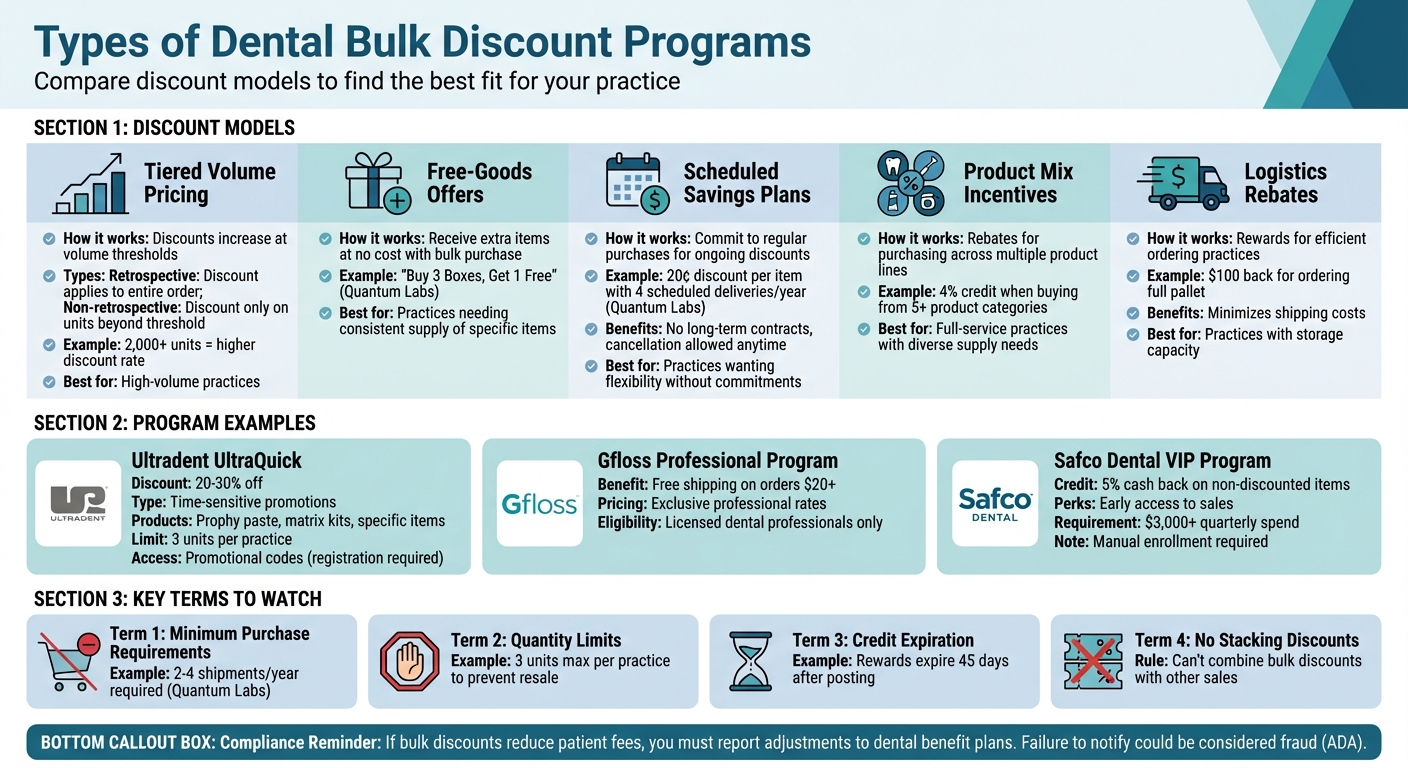
One popular option is tiered volume pricing, where discounts increase as you hit specific volume thresholds. In a retrospective model, meeting a threshold (like 2,000 units) applies the discount to your entire order. On the other hand, non-retrospective models only apply the higher discount to the units purchased beyond the threshold.
Another common approach is free-goods offers, where you receive additional items at no extra cost when you buy in bulk. For instance, Quantum Labs’ “Buy 3 Boxes, Get 1 Free” deal is a classic example of this type of program.
For practices looking for flexibility, scheduled savings plans are a great fit. These programs reward you for committing to regular purchases without locking you into long-term contracts. Quantum Labs, for example, offers a 20¢ discount per personalized lip balm if you schedule four box deliveries throughout the year. Plus, cancellations are typically allowed at any time.
If you’re buying across multiple categories, product mix incentives can help you save even more. Some suppliers offer rebates, such as a 4% credit, when you purchase from five or more product lines. Similarly, logistics rebates provide rewards for efficient ordering, like $100 back for ordering a full pallet, which also helps minimize shipping costs.
Terms and Conditions to Know
Most bulk discount programs come with minimum purchase requirements. For example, Quantum Labs’ scheduled plans require at least two to four shipments per year to qualify.
It’s also important to watch for quantity limits. Programs like Ultradent’s UltraQuick promotions, which offer 20–30% off certain items, often cap purchases at three units per practice to prevent resale and ensure more offices can benefit.
Other key terms include credit expiration dates - some rewards expire just 45 days after they’re posted - and restrictions on combining discounts. Typically, you can’t stack bulk discounts with other sales or special pricing.
Additionally, there are compliance requirements tied to insurance. The American Dental Association advises:
The patient’s dental benefit plan should be informed of any fee adjustment through a separate paper claim or as an attachment to a reimbursement submission. Failure to notify the plan of any accounting reduction could be considered fraud.
If bulk discounts lead to lower patient fees, remember to apply similar adjustments for insurance plan members as required. Keeping these terms in mind will help you make the most of bulk discount opportunities.
Examples of Discount Programs
Programs like Ultradent’s UltraQuick offer time-sensitive discounts of 20–30% on specific products such as prophy paste and matrix kits. These deals are accessed through promotional codes, but registration as a dental professional is required.
The Gfloss Professional Program provides perks like free shipping on orders over $20 and exclusive pricing that isn’t available to the general public.
For practices with higher spending, Safco Dental’s VIP Program offers a 5% cash credit on non-discounted items and early access to sales for those spending over $3,000 quarterly. Keep in mind, though, that you need to enroll manually, and you can’t participate in multiple credit programs with the same supplier at the same time.
Eligibility and Enrollment
Who Qualifies?
Bulk discount programs are typically open to licensed professionals such as dentists, hygienists, orthodontists, and others in the dental field. To qualify, you’ll generally need a valid dental license and professional credentials.
Some programs, especially higher-tier ones, may have extra requirements. For instance, Safco Dental’s VIP Program asks practices to spend at least $3,000 per quarter to stay eligible, although this spending minimum is waived for the first quarter. Members of professional organizations like the American Dental Association (ADA) or state groups such as the Georgia Dental Association can also access exclusive discounts. These include savings on UPS shipping, with discounts ranging from 42% to 65% on U.S. shipments.
Other programs are more flexible. Quantum Labs’ Savings Plan, for example, doesn’t require a minimum spend. Instead, you qualify by scheduling 2 to 4 shipments per year. This unlocks deals like “Buy 3 Boxes, Get 1 Free” on toothbrushes. Even dental students can join, though some products may be excluded.
Once you’ve confirmed your eligibility, the next step is signing up.
How to Enroll
Enrollment is straightforward and can be done online, by phone, or through sales representatives. For example, The Dentists Supply Company (TDSC.com) offers instant VIP pricing when you provide your ADA number during account creation. They’ll then verify your State Dental Association membership within 90 days to grant permanent VIP status. Safco Dental’s VIP program requires you to opt in by emailing your purchase history to VIP@safcodental.com for an expense review. Meanwhile, Quantum Labs’ Savings Plan can be set up with a quick call to 1-800-328-8213 - no membership fees or contracts needed.
To speed up the process, have your ADA number and recent supplier invoices ready. Also, check if your state dental association has partnerships with specific distributors, as these can unlock special pricing tiers.
Compliance Requirements
Once enrolled, you’ll need to follow specific usage and reporting rules.
Most bulk discount programs are strictly for internal practice use. Reselling products to third parties is prohibited, and any orders flagged as reseller purchases will be canceled.
If your discounted purchases lead to reduced patient fees, you’re required to report these changes to dental benefit plans. To avoid misuse, create a written financial policy outlining how discounts are applied and ensure your staff understands and acknowledges it. Keeping your dental license records up to date is also crucial to prevent delays or the risk of losing program privileges.
sbb-itb-9fc6c7c
How to Maximize Your Savings
Assess Your Practice Needs
Take a close look at your purchase history from the past year to identify patterns in usage and seasonal trends. A smart way to organize this is by using the ABC method: categorize essential supplies as "Always", moderately-used items as "Better", and infrequent purchases as "Control." This helps you focus bulk buying on the items you need most, saving money without overstocking less critical supplies.
Be mindful of expiration dates, particularly for items like composite resins, anesthesia, and medications. Set up reorder alerts in your inventory system to ensure you never run out of key items. Additionally, keeping surplus stock in one centralized location - rather than scattering it across multiple cabinets - can help you avoid duplicate orders and track inventory more accurately.
"Analyzing supply usage is not a one-time task but a continuous process. As practices grow, add new services, or experience changes in patient demographics, their supply needs will evolve."
– Harsh, LinkedIn Guide
After you’ve reviewed your inventory, compare supplier options to ensure you’re getting the best value for your money.
Compare Suppliers and Programs
Did you know that the cost of the same OEM (Original Equipment Manufacturer) product can vary by as much as 50% depending on where you buy it? Dr. Pat Cassidy, Chief Dental Officer at Net32, explains:
"Depending on where you source your supplies, pricing for the exact same OEM (Original Equipment Manufacturer) product can vary widely. Savings up to and beyond 50% are commonplace."
When comparing suppliers, consider the trade-offs. Large national distributors typically offer a wide range of products but may charge higher prices. Smaller regional vendors might offer more competitive rates on consumables, and buying directly from manufacturers can often result in the lowest prices. Online marketplaces, driven by competition, can also help you save. Don’t forget to review return policies - having a safety net like a 30-day money-back guarantee can protect your practice if a bulk purchase doesn’t meet your needs.
Here are key factors to evaluate when comparing suppliers:
| Comparison Factor | Why It Matters |
|---|---|
| Unit Price | Helps determine true per-item savings. |
| OEM Status | Ensures quality and authenticity of products. |
| Shipping Thresholds | Reduces costs by qualifying for free shipping. |
| Return Policy | Provides security if products don’t meet expectations. |
| Price-Matching | Lets you stick with preferred vendors while cutting costs. |
By shopping carefully, you could lower your dental supply expenses from the typical 6%–8% of total costs to around 4%–5%. Using procurement software can simplify this process, helping you analyze costs and request quotes from multiple suppliers.
Once you’ve identified cost-effective suppliers, test their products to ensure quality before committing to large orders.
Test Products with Free Samples
Before making a bulk purchase, take advantage of free sample programs to assess product quality and suitability.
"Before you purchase a new product, you should run a trial to test its quality and fit for your Doctors and employees."
Many major manufacturers, such as Haleon and TePe, provide free samples to licensed dental professionals. For example, Haleon offers:
"To show our support for you, we are pleased to offer limited quantities of select product samples at no cost to eligible healthcare professionals throughout the year."
To access these samples, register with manufacturer portals using your professional office address, as many suppliers require a clinical address for eligibility. Websites like Free Dental Samples for Professionals can connect you with multiple suppliers, offering trial kits for categories like restorative, preventive, whitening, adhesives, and orthodontics.
Consider forming an internal committee to evaluate and rate the samples before adding them to your inventory. Free samples can also double as an educational tool for patients, showcasing new products or treatments. If free samples aren’t available, reach out to major distributors such as Henry Schein, Patterson Dental, or Benco Dental to explore sample purchasing options.
Conclusion
Key Takeaways
Managing dental supply costs is crucial for maintaining healthy profit margins. Financial experts suggest independent dentists allocate just 5% to 6% of their total production budget to dental supplies. Bulk discount programs can play a significant role in hitting this target by offering savings through volume-based tiers, loyalty rewards, and association memberships, often cutting supply costs by 15% to 25%.
When choosing a bulk discount program, it's important to align it with your practice's specific needs. Memberships with organizations like the ADA or state dental associations can be particularly beneficial, providing access to vetted suppliers and shipping discounts that range from 42% to 65%.
Once you've selected a program, take steps to ensure product quality. Free sample programs can help you test supplies before committing to large orders, reducing the risk of costly mistakes. Websites such as Free Dental Samples for Professionals offer trial kits across various categories to help you make informed decisions.
Lastly, stay compliant with dental benefit plan requirements. Any fee adjustments must be reported to avoid potential issues. The American Dental Association emphasizes this point:
"Failure to notify the [dental benefit] plan of any accounting reduction could be considered fraud".
FAQs
What steps do dental professionals need to take to qualify for bulk discount programs?
Dental professionals can take advantage of bulk discount programs by following a few straightforward steps that most suppliers typically require:
- Register your professional status: Suppliers often need you to confirm your role, such as dentist or hygienist, and provide details about your practice. This usually involves filling out a quick online form.
- Ensure you meet the criteria: Some programs have specific requirements, like a minimum spending amount, membership in a professional organization, or a confirmation that the purchases will be used for your practice. For instance, some suppliers might set quarterly spending benchmarks or require proof of membership in a dental association.
- Submit necessary documentation: You may need to provide proof of your professional credentials, such as a dental license, DEA registration, or even a utility bill with your practice's address.
Once these steps are completed, dental professionals can unlock perks like exclusive discounts, free samples, and other incentives that make buying in bulk a smart choice for running a cost-efficient practice.
How can dental professionals save the most money through bulk purchasing?
To make the most of bulk purchasing and cut down on costs, start by analyzing your past orders. Look for items you use frequently and identify any unnecessary expenses. Compare your supply costs to industry standards - ideally, aim to keep them within 5–6% of your production costs. Use this insight to negotiate better deals, such as discounts, tiered pricing, or promotions like "buy three, get one free."
Joining group purchasing organizations (GPOs) or professional associations can also lead to big savings. These groups use collective buying power to secure discounts, often saving members 15–25%. Another tip? Consolidate your orders to hit volume thresholds and reduce shipping costs. You can also bundle related items, such as pairing toothbrushes with toothpaste or floss, to take advantage of mix-and-match offers.
Don’t overlook free sample programs as a way to try new products without spending a dime upfront. Platforms like Free Dental Samples for Professionals offer trial kits in various categories, allowing you to test products before committing to a bulk order. By combining these strategies, you can save money while continuing to provide top-notch care for your patients.
What legal and ethical considerations apply when using bulk discounts in dental practices?
When offering bulk discounts, dental practices need to navigate the Federal Anti-Kickback Statute (AKS) with care. This law prohibits discounts or incentives that might be considered payment for referring patients covered by federal health programs like Medicare or Medicaid, unless they meet specific "safe harbor" criteria. To ensure compliance, practices should carefully document the terms of any discounts, confirm they are available equally to all eligible providers, and ensure that no patient referrals are linked to the discount.
Beyond federal laws, practices must also consider state regulations and ethical codes within the dental industry. For instance, some state dental boards explicitly ban incentives that could be seen as kickbacks or rebates. Additionally, contracts with insurers often restrict fee adjustments outside the agreed terms, so reviewing these agreements is essential. To steer clear of potential issues, practices should consistently document their discount policies, apply them fairly, and provide staff with proper training on the relevant legal and ethical guidelines.


